
Chatham County Criminal Court Files
A criminal court record is the case file kept by the Clerk of Superior Court once a criminal case is filed in court. It may include charging documents, warrants or criminal summonses, citations, indictments, appearances, bond orders, pleas, motions, hearing entries, judgments, sentences, probation terms, continuances, and dismissal or disposition entries. It is the court-side history of the case, so it can show a charge that was later dismissed, reduced, superseded by indictment, consolidated for judgment, or resolved by plea or trial.
Chatham County criminal cases are handled inside North Carolina's unified state court system. Superior Court is the higher trial court for felony prosecutions after indictment or transfer. District Court handles misdemeanors, infractions, many first appearances, and high-volume criminal calendars. Magistrates handle first-line functions such as warrants or summonses, initial appearances, and bond decisions. The District Attorney for Prosecutorial District 18 prosecutes criminal cases for Chatham and Orange Counties, and the Chatham contact directory lists the District Attorney phone as (919) 545-3510.
The NC criminal cases help topic is one of the criminal court records manifest images.
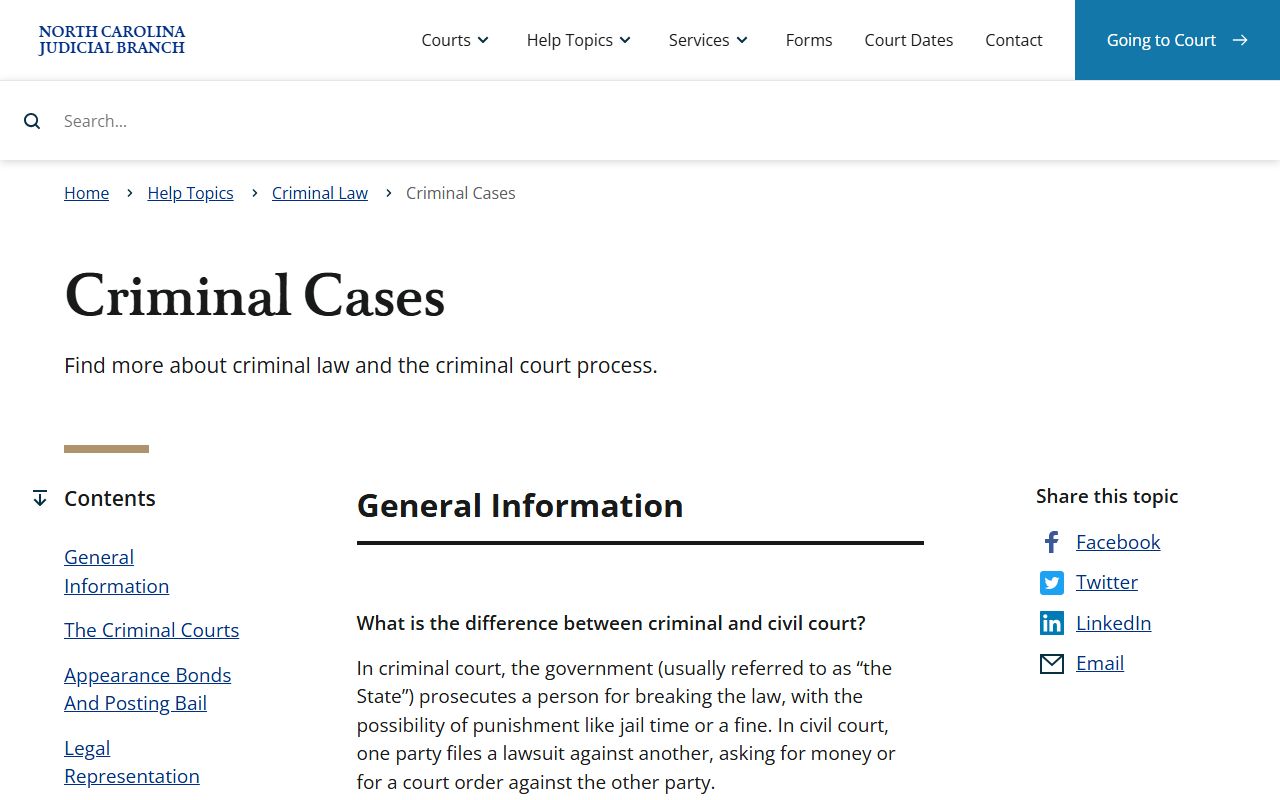
That source supports the case-file focus because it explains the criminal case path and the role of charging documents and case numbers.
Search Chatham County Criminal Records
For current public Chatham County criminal court records, start with NC Portal Smart Search. Search by defendant name, record number, or case number, and use Advanced Filtering Options to narrow by Chatham County, case type, case status, and filing date. The Portal requires JavaScript and cookies, supports registration and sign-in, and uses CAPTCHA every ten minutes. If a result is incomplete or a certified copy is needed, contact the Chatham County Clerk of Superior Court at the courthouse in Pittsboro.
- Open Smart Search and enter the defendant name in Last, First Middle Suffix format, or enter the criminal case number.
- Use Chatham County as the location filter when advanced filtering is available.
- Check the case type, status, filing date, and visible docket entries for the criminal matter.
- Use Search Hearings if the main question is the next criminal court date or courtroom.
- Request file review or certified copies from the Clerk of Superior Court when the online result is not enough.
For a closer look at the arrest-to-charging path, use Chatham County arrest records and court charges. That charge-focused record is not the same as the full criminal case file. For formal statewide criminal-history searches, the NC Judicial Branch criminal background check process should be used rather than relying only on a Portal screen.
Chatham County Criminal Case Flow
A Chatham County criminal court record grows as the case moves through the system. The first public clue may be a citation, warrant, criminal summons, arrest blotter entry, or inmate card. The court case then develops through appearances, filings, hearings, and disposition. Felony cases often begin with District Court proceedings and move to Superior Court after indictment or transfer. Misdemeanors often remain in District Court unless appeal or other procedure changes the path.
Case flow: Charges Filed › Arraignment › Pretrial / Motions › Plea or Trial › Disposition › Sentencing
| Stage | What Happens | Record Clue |
|---|---|---|
| Charges Filed | A citation, warrant, summons, indictment, or other charging paper starts the court record. | Charge, case number, offense date, issuing process. |
| Arraignment | The defendant is advised of the charge and a plea process begins. | Plea or setting entry, attorney information, next date. |
| Pretrial / Motions | The parties file motions, continue settings, negotiate, or prepare for trial. | Motions, orders, continuances, hearing entries. |
| Plea or Trial | The case is resolved by plea, bench or jury trial, dismissal, or another authorized outcome. | Verdict, plea entry, dismissal, or negotiated result. |
| Disposition / Sentencing | The court enters the final outcome and sentence when there is a conviction or responsible finding. | Judgment, sentence, probation, costs, restitution, or active term. |
The NC crime victims help topic explains the difference between a warrant and a criminal summons in the magistrate process.
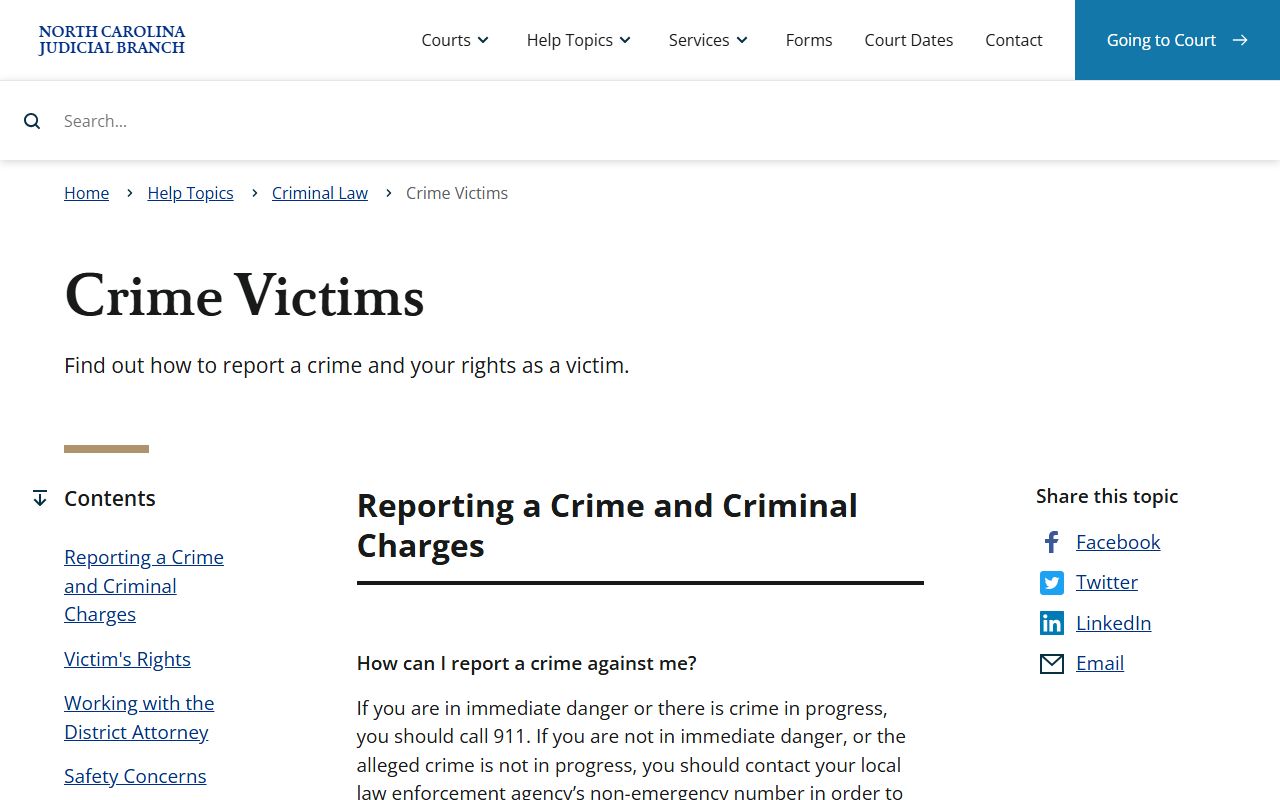
That distinction helps explain why one criminal case may begin with an arrest while another begins with service of a summons and no jail booking.
Chatham County Criminal Record Fields
North Carolina case numbers often begin with the last two digits of the year in which the person was charged or the case was filed. In Chatham County, the criminal court record may show the county or location, court division, filing or offense date, defendant, attorney, prosecutor, charges, bond activity, docket entries, hearings, pleas, judgments, sentence, probation, financial obligations, and final status. Portal and courthouse terminals may expose different fields depending on case type, public access level, and whether the case has restricted documents.
| Field | What It Shows |
|---|---|
| Case Number | The unique criminal court number, often tied to filing year and case type. |
| Defendant | The person charged in the criminal case. |
| Charge | The alleged offense or infraction before final disposition. |
| Bond | Release conditions set by a magistrate or judge, such as secured, unsecured, cash, or no bond when shown. |
| Plea | The defendant's formal response, such as guilty, not guilty, or other plea entry available in the record. |
| Docket Entry | A dated event such as hearing set, motion filed, order entered, continuance, or judgment. |
| Disposition | The result, such as dismissed, guilty, not guilty, deferred, disposed, or consolidated for judgment. |
| Sentence | Punishment after conviction, including active time, probation, fines, costs, restitution, or conditions. |
A criminal court field can be easy to misread. "Charge" is an accusation or filed count. "Disposition" is the result. "Sentence" is the punishment only if the case ends in conviction or another sentencing event. A dismissed charge may still appear in the court history unless sealed or expunged through the proper process.
Chatham County Charges vs Convictions
A Chatham County criminal court record can include charges that never became convictions. A prosecutor may dismiss, amend, reduce, negotiate, or pursue charges based on evidence, criminal procedure, and court rulings. The District Attorney's Office prosecutes cases for the State of North Carolina, but a private person reading a court record should not treat the first charge entry as the final result. The disposition and judgment fields carry the outcome.
| Point | Charge | Conviction |
|---|---|---|
| Meaning | An allegation filed by citation, warrant, summons, indictment, or other charging paper. | A final outcome based on a guilty plea, verdict, or other conviction entry. |
| Timing | Appears early in the criminal case file. | Appears after plea, trial, or judgment. |
| Can change? | Yes. It may be amended, dismissed, reduced, or superseded. | It changes only through post-judgment action, appeal, correction, or qualifying relief. |
| How to verify | Review the charge entry and later docket history. | Review disposition, judgment, sentence, and certified record if needed. |
The District Attorney county lookup is a manifest source for the Chatham criminal court records page.
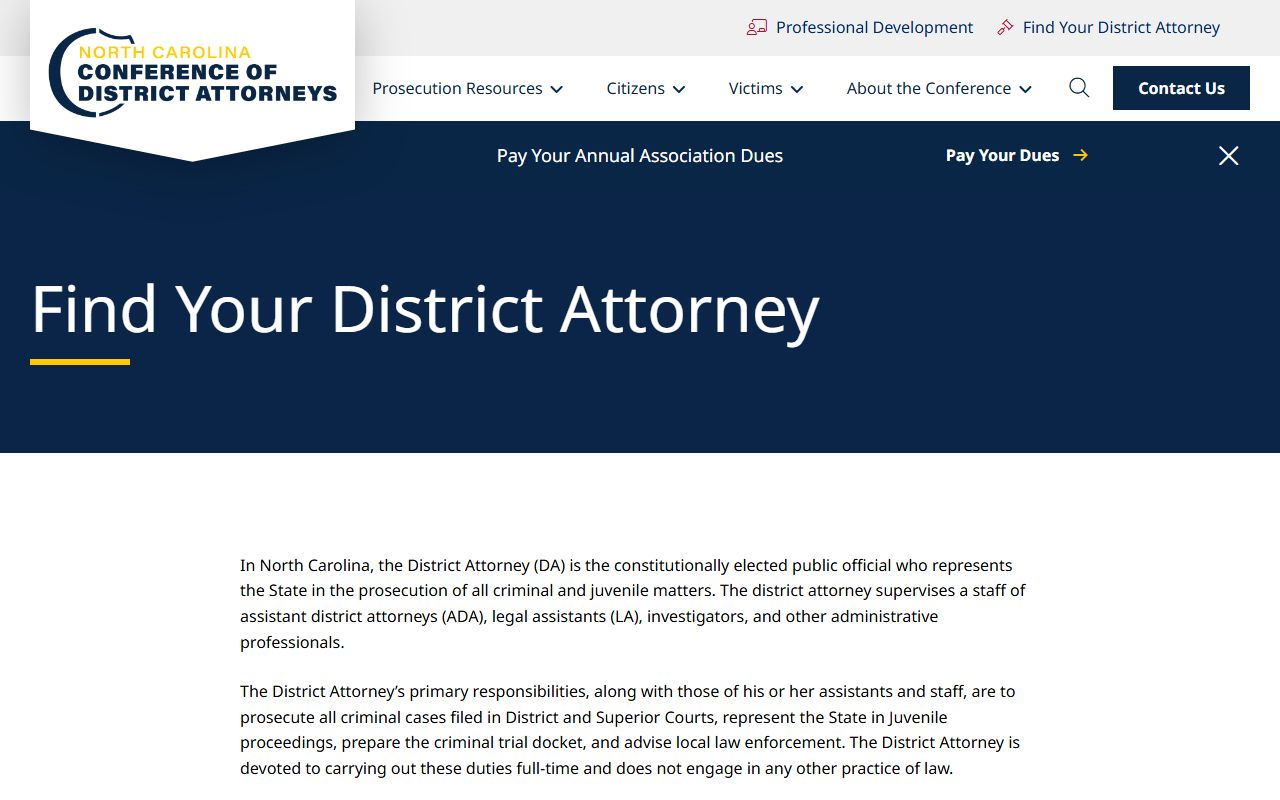
That source supports the prosecution role in District 18, while the court record itself remains the source for the final criminal case result.
Chatham County Criminal Records Access
Public access to Chatham County criminal court records is based on court-record rules and public-records law. N.C. Gen. Stat. § 7A-109 requires clerks to keep records, files, dockets, and indexes and makes them public during regular office hours unless prohibited by law. N.C. Gen. Stat. § 132-1 defines public records, and N.C. Gen. Stat. § 132-6 addresses inspection and copies at reasonable times.
Practical access has three tracks. First, use NC Portal Smart Search for public case information and visible records. Second, use public self-service terminals in clerk offices when a courthouse search is needed. Third, contact or visit the Chatham County Clerk of Superior Court for paper files, older files, certified copies, or questions about a Chatham criminal case. A statewide background check is a different product and should follow the official NC criminal background check process.
Note: Portal access may show limited public detail, while certified criminal record searches follow a separate court process.
Chatham County Sealed vs Expunged Records
Sealed and expunged criminal records should not be described as available through ordinary Chatham County criminal court records search. A sealed record is removed from general public access by law or court order but may still exist for limited authorized access. An expunction is a statutory clearing of eligible public record entries. North Carolina law treats expunction as more than a dismissal, and eligibility depends on case type, charge, conviction status, waiting period, age, and prior record.
| Point | Sealed | Expunged |
|---|---|---|
| Public visibility | Hidden from ordinary public search or inspection. | Public record entries are cleared under an expunction order. |
| Record existence | The file may still exist with restricted access. | The record is treated under the expunction statute after the order. |
| North Carolina source | May come from statute or court order, depending on record type. | Chapter 15A expunction statutes and NC Judicial Branch expunction forms. |
| User caution | Do not assume a sealed case can be viewed without court authority. | Do not assume every dismissed or old charge qualifies. |
The NC expunction help topic and Chapter 15A statutes are assigned to this criminal court records page in the image manifest.
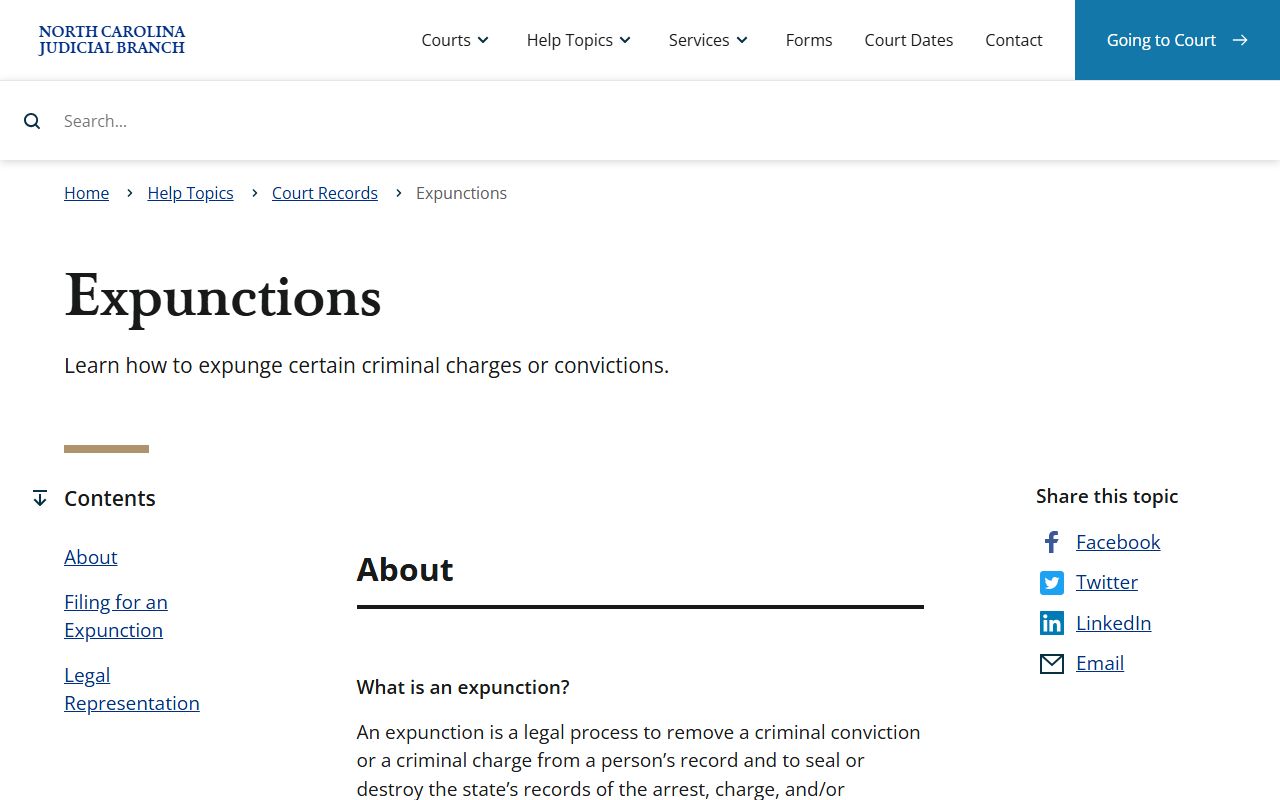
The help topic explains the court process at a high level, while the statutes define when public record entries may be cleared.
N.C. Gen. Stat. § 15A-145.5 covers expunction of certain nonviolent misdemeanors and felonies.
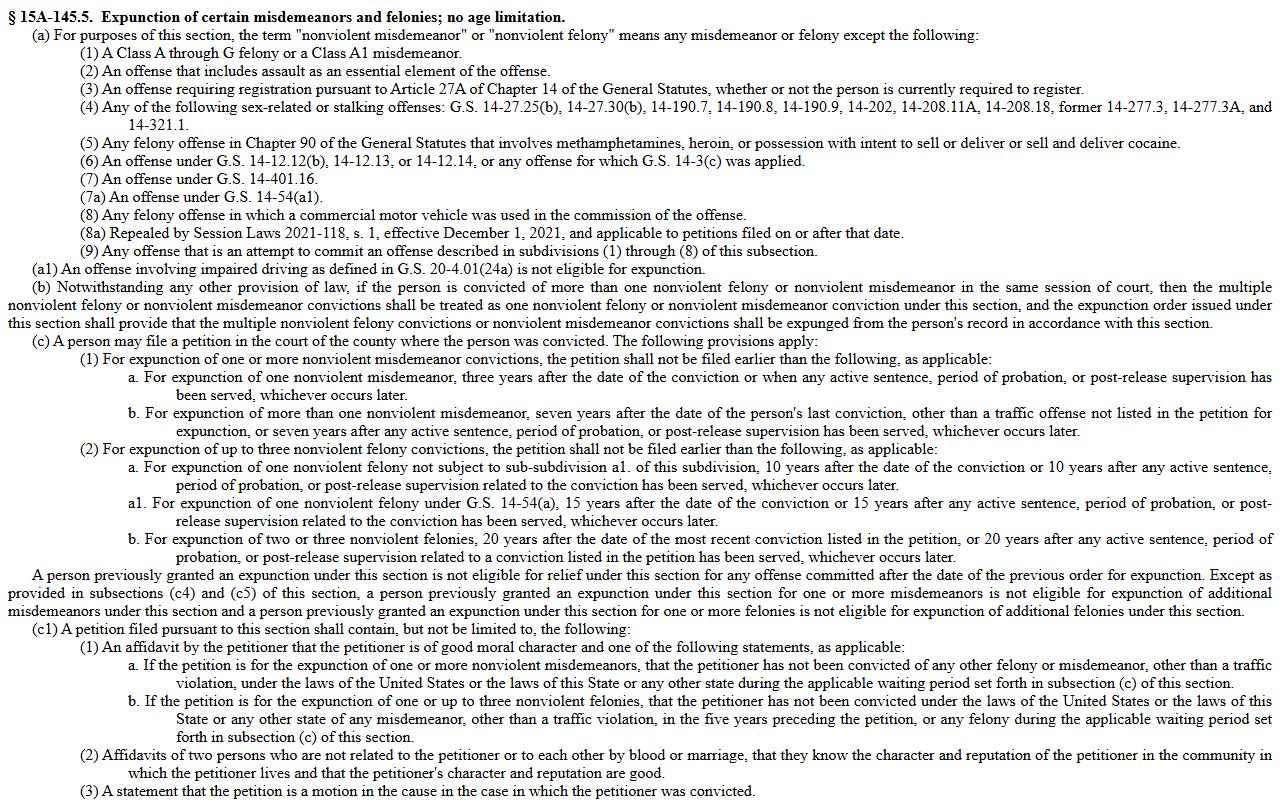
That statute is relevant only when its eligibility rules fit the exact Chatham County charge, disposition, and prior-record facts.
N.C. Gen. Stat. § 15A-153 explains the effect of expunction on public record entries.
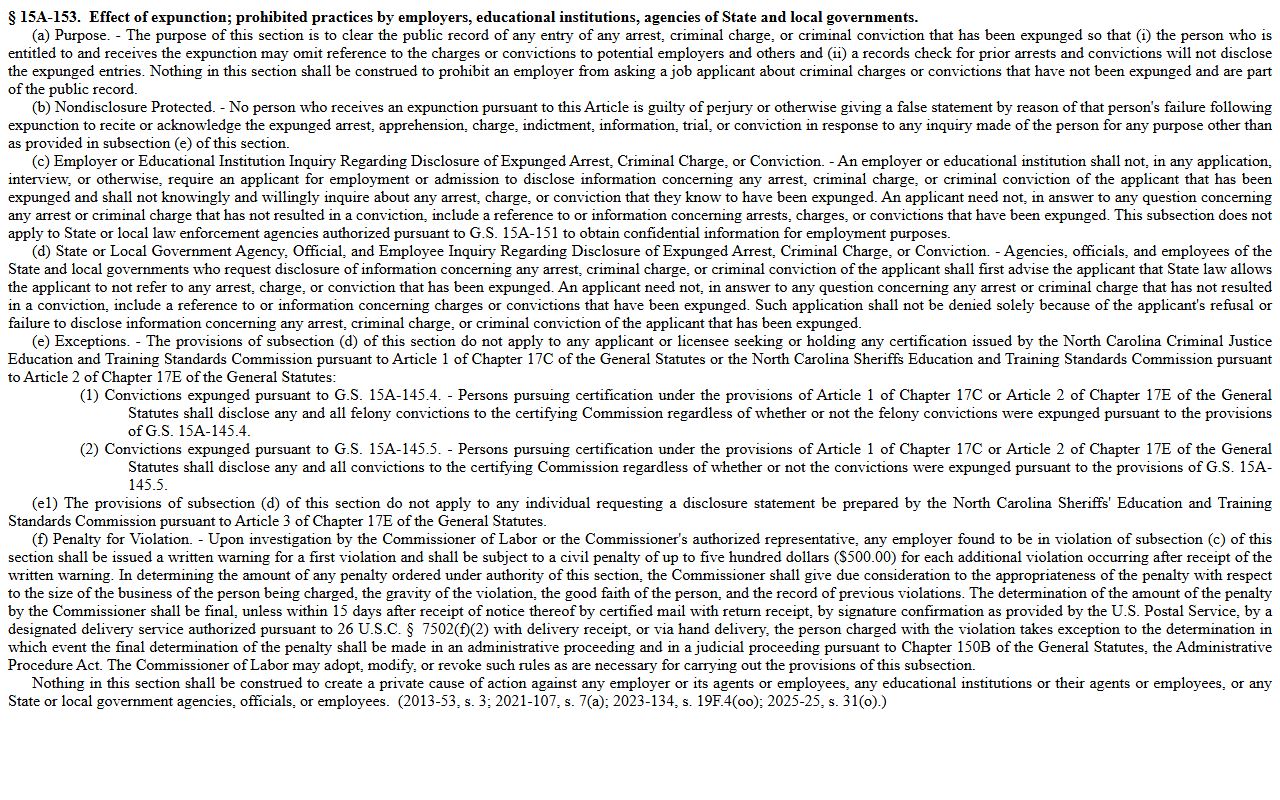
The effect statute is why a cleared record may not appear in public searches even though older unofficial copies could still exist elsewhere.
Restricted Chatham County Criminal Records
Juvenile criminal matters are not ordinary public criminal court records. North Carolina juvenile law creates a separate juvenile court record maintained by the clerk and restricts public inspection. Chatham's contact directory lists Juvenile Court Counselors at (919) 542-3340, which reflects the separate juvenile process. Sealed indictments, active investigations, protected victim information, domestic violence safety details, mental health records, and minor identifying information may also be withheld, redacted, or limited.
The practical expunction path starts with the exact county, case number, charge, and disposition. Use Smart Search or a clerk terminal to confirm what happened, then review the NC Judicial Branch expunction help topic and the relevant Chapter 15A statute. Petitions are filed in the Clerk of Superior Court for the county where the charge occurred unless the official form says otherwise. The prosecutor, court, and state agencies may review the petition before any order is entered.
Clerk of Superior Court
Chatham County Courthouse
40 E Chatham Street
Pittsboro, NC 27312
(919) 545-3500
Monday-Friday, 8:30 a.m.-5:00 p.m.